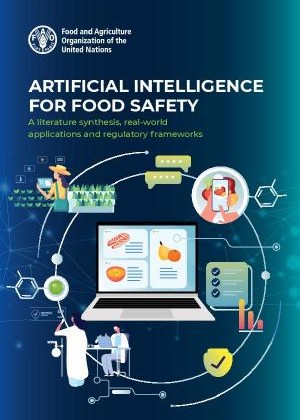
Artificial Intelligence (AI) is increasingly applied in food safety management, offering new capabilities in data analysis, predictive modelling, and risk-based decision-making. A review of the literature identifies three primary areas of application: scientific advice, inspection and border control, and operational activities of food safety competent authorities. Five country examples with the real-world use cases illustrate diverse uses of AI tools, including pathogen detection, import sampling prioritization, and language models for regulatory data processing. Regulatory frameworks, as well as voluntary governance, addressing AI in the public sector are emerging worldwide. National and international initiatives often highlight the importance of data governance, transparency, ethical considerations, and human oversight. Challenges such as biased data, explainability, and data governance gaps appear across different contexts, along with potential risks from deploying AI systems prematurely. Access to high-quality, interoperable data and collaboration among stakeholders can support effective integration of AI technologies. AI readiness often depends on understanding specific problems to be addressed, current capacities, and the quality of available data. Human oversight and continuous evaluation contribute to maintaining trust in AI systems. Collaborative efforts involving academia, the private sector, and international organizations help build shared knowledge and resources for AI development in food safety. Overall, AI presents opportunities to enhance resilience, efficiency, and responsiveness in food safety systems. Careful consideration of governance, data management, and multi-stakeholder cooperation can shape AI’s contribution to achieving sustainable and equitable outcomes in agrifood systems.
Índice
1. Introduction 1.1. Background 1.2. Relevance to food safety in the agrifood systems 1.3. Purpose of the document and target audience 1.4. Methods
2. Literature synthesis results 2.1. Overview 2.2. Applications of artificial intelligence in food safety management 2.3. Algorithms
3. Artificial intelligence case studies for food safety management 3.1. Overview 3.2. Use cases of traditional and generative artificial intelligence 3.3. Using machine learning to predict pathogen adaptation to food sources 3.4. Import sampling prioritization with machine learning 3.5. Proof-of-concept experimentation using language models for food safety 3.6. Building human-centric artificial intelligence systems for emerging food safety risk identification
4. A global regulatory snapshot of artificial intelligence frameworks 4.1. Responsible use of artificial intelligence within the public sector 4.2. Example of preliminary activities conducted by authorities 4.3. Global efforts and good practices 4.4. International and multisectoral collaboration and partnership
5. Considerations for the use of artificial intelligence in food safety management 5.1. Identify the problem first 5.2. Value of the artificial intelligence tools 5.3. Value of the artificial intelligence outputs 5.4. Explainable artificial intelligence 5.5. Possible pitfalls, challenges and risk management 5.6. Data governance and data gaps 5.7. Public algorithm sharing mechanisms 5.8. Artificial intelligence literacy and capacity development 5.9. Support for data-driven decision-making
6. Tips for food safety competent authorities 6.1. Consider some key activities to be completed first 6.2. Assess the current capacity for artificial intelligence development 6.3. Ensure the readiness of data 6.4. Step back and take a strong agrifood systems approach 6.5. If the data is not ready, consider generating quality data for the long run 6.6. Actively collaborate with various stakeholders for artificial intelligence development
Utilizamos cookies propias y de terceros para ofrecer nuestros servicios y recoger información estadística. Puede aceptar todas las cookies pulsando el botón “Aceptar” o configurarlas o rechazar su uso clicando a la
Política de cookies
Son aquellas que permiten al usuario la navegación a través de una página web, plataforma o aplicación y la utilización de las diferentes opciones o servicios que en ella existan.
poscosecha.com
avis-cookies
1 año
Cookie necesaria para la utilización de las opciones y servicios del sitio web
poscosecha.com
PHPSESSID
12 horas
Cookies generada por las aplicaciones basadas en el lenguaje PHP. Se trata de un identificador de propósito general usado para mantener las variables de sesión de usuario. Normalmente es un número generado al azar, cómo se utiliza puede ser específica para el sitio, pero un buen ejemplo es el mantenimiento de una sesión iniciada en el estado de un usuario entre las páginas.
poscosecha.com
XSRF-TOKEN
12 horas
Es una cookie encriptada que sirve para controlar que todos los envíos de formularios son realizados por el usuario actualmente en sesión, evitando ataques CSRF (Cross-Site Request Forgery).
Son aquellas que permiten al responsable de las mismas el seguimiento y análisis del comportamiento de los usuarios de los sitios web a los que están vinculadas.
poscosecha.com
_ga
2 años
La cookie _ga, instalada por Google Analytics, calcula los datos de visitantes, sesiones y campañas y también realiza un seguimiento del uso del sitio para el informe analítico del sitio. La cookie almacena información de forma anónima y asigna un número generado aleatoriamente para reconocer a visitantes únicos.
poscosecha.com
_ga_*
2 años
Google Analytics configura esta cookie para almacenar y contar las visitas a la página.
youtube.com
CONSENT
2 años
YouTube establece esta cookie mediante vídeos de youtube incrustados y registra datos estadísticos anónimos.
Son aquellas que permiten la gestión, de la forma más eficaz posible, de los espacios publicitarios que, en su caso, el editor haya incluido en una página web, aplicación o plataforma desde la que presta el servicio solicitado en base a criterios como el contenido editado o la frecuencia en la que se muestran los anuncios.
youtube.com
yt-remote-connected-devices
nunca
YouTube establece esta cookie para almacenar las preferencias de vídeo del usuario que utiliza el vídeo de YouTube incrustado.
youtube.com
yt-remote-device-id
nunca
YouTube establece esta cookie para almacenar las preferencias de vídeo del usuario que utiliza el vídeo de YouTube incrustado.
youtube.com
VISITOR_INFO1_LIVE
5 meses
Una cookie establecida por YouTube para medir el ancho de banda que determina si el usuario obtiene la interfaz del reproductor nueva o antigua.
youtube.com
YSC
sesión
La cookie YSC la configura Youtube y se utiliza para realizar un seguimiento de las visualizaciones de los vídeos incrustados en las páginas de Youtube.
Utilizamos cookies propias y de terceros para ofrecer nuestros servicios y recoger información estadística. Puede aceptar todas las cookies pulsando el botón “Aceptar” o configurarlas o rechazar su uso clicando a la
Política de cookies










.gif "Banners Braulio")




.jpg)